.png)
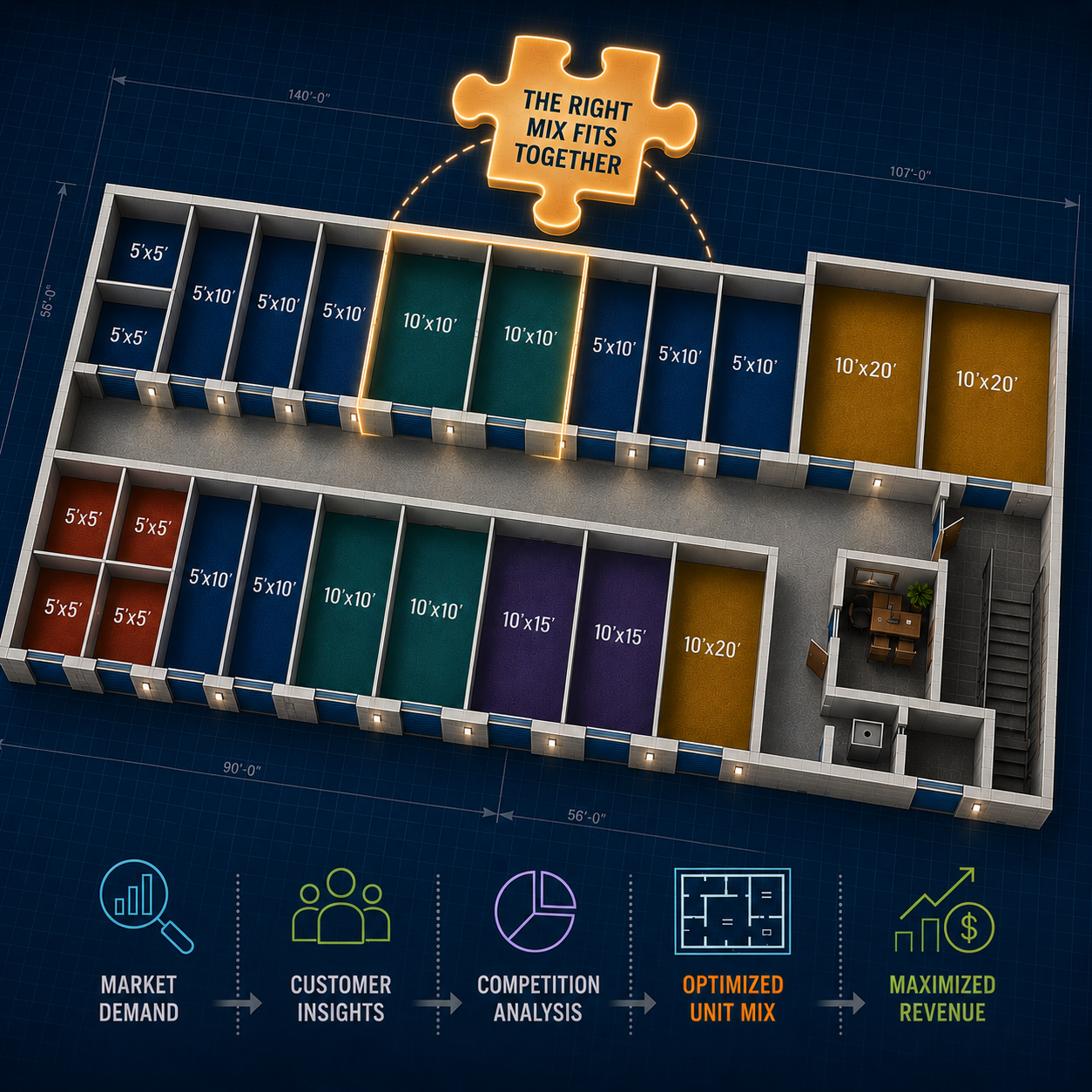
The Decision Most Developers Make Without Realizing Its Full Impact When planning a self-storage facility, unit mix is almost always part of the conversation. Developers think about it, ask about it, and make decisions around it early in the process. It's not an overlooked detail so much as an underestimated one.
What's less commonly understood is just how much the unit mix decision influences overall facility performance. It's easy to treat it as a layout question when it's really a revenue question. Two facilities built on similar sites, with similar budgets and similar total square footage, can perform very differently based largely on how that space is divided.
Getting unit mix right doesn't just affect how a facility looks on paper. It shapes how it performs from the moment leasing begins.
What Self Storage Unit Mix Really Means
On paper, unit mix is straightforward: it's the distribution of sizes throughout your facility, from 5x5s to 10x10s to 10x20s and beyond. In practice, it carries more strategic weight than it might initially appear.
Every market has its own demand profile. In more urban environments, smaller units can move quickly as residents manage limited living space. In suburban markets, mid-sized units often carry a larger share of demand as homeowners look for supplemental storage. In certain locations, larger units may serve vehicle storage or commercial tenants well. Climate-controlled configurations add another layer of complexity depending on regional conditions and renter expectations.
One of the most effective ways to approach unit mix planning is to think about customer profiles before unit dimensions. While developers often focus on the percentage of 5x5s, 10x10s, or 10x20s in a facility, successful operators tend to focus on who is most likely to rent those spaces. Residential movers, apartment dwellers, small businesses, contractors, e-commerce operators, document storage users, and vehicle owners all have different storage needs. Understanding the customer base a facility is intended to serve can provide valuable insight into the unit sizes, access configurations, and amenities that are most likely to succeed in a given market.
The challenge isn't deciding whether to think about unit mix. It's knowing how much weight to give it and having the right information to make those sizing decisions with confidence.
Why Unit Mix Has More Influence Than Most Plans Account For
A well-optimized self storage unit mix doesn't just fill a facility. It helps the facility perform as a whole.
When your storage unit size mix aligns with what the local market is actively seeking, leasing tends to be more consistent and predictable. Rather than certain unit types sitting vacant while others stay perpetually full, demand is spread more evenly across the property, which supports both occupancy rates and overall revenue.
There's also a meaningful relationship between unit mix and how revenue is generated. Smaller units can produce higher revenue per square foot, while larger units allow you to lease bigger blocks of space more efficiently. The goal isn't to favor one category over another. It's to find the balance that allows the entire facility to contribute to income.
That balance also plays a role in lease-up speed. Facilities that align well with their market tend to build occupancy faster, which can meaningfully improve early cash flow and reduce the pressure of those first critical months.
Occupancy doesn't always tell the whole story. A facility that is 90% occupied with balanced demand across its core unit sizes may ultimately outperform a facility that is 95% occupied but relying on discounts and promotions to fill an overbuilt segment of inventory.
Consider two developers building in the same market. Developer A creates a balanced unit mix that aligns with local demand. Developer B allocates a significantly larger percentage of the facility to smaller units because the higher revenue-per-square-foot projections make the pro forma more attractive. While both facilities may eventually reach similar occupancy levels, the overbuilt facility often experiences slower lease-up, greater reliance on promotions, and less flexibility to increase rates.
This is where unit mix directly impacts pricing power. When demand is healthy across all major unit types, operators can adjust rates strategically and maximize revenue. When a particular unit size is overbuilt, operators may be forced to offer concessions or keep rates lower simply to maintain occupancy. The result is that two facilities in the same market can report similar occupancy while producing very different financial results.
The goal isn't simply to fill units. It's to create a unit mix that supports strong lease velocity, minimizes concessions, and allows operators to maintain pricing power over the life of the asset.
Where Unit Mix Decisions Can Go Wrong
The issue with unit mix usually isn't that it goes unconsidered. It's that the decisions get made without a complete picture of what the market actually supports.
A common example is using a nearby competitor's layout as a reference point. It's a reasonable instinct, but without knowing how those units are actually performing, it's easy to replicate a mix that looks sensible on paper but doesn't reflect real local demand.
Another trap developers occasionally fall into is allowing the pro forma to drive the unit mix rather than using market demand to inform the pro forma. Because smaller units often generate higher revenue per square foot, it's tempting to load a facility with a large quantity of 5x5s and 5x10s simply because the math makes the projected returns look more attractive. On paper, dozens of smaller units rented at projected rates can make a development model "work." The challenge is ensuring the unit mix reflects how customers in that market actually rent storage, not just what produces the most favorable spreadsheet. A successful facility balances financial modeling with real-world demand.
Overbuilding larger units is another pattern that tends to surface in hindsight. They can appear attractive from a rental standpoint, but if the surrounding market doesn't generate sufficient demand, they often take longer to absorb. In those situations, developers often ask whether larger units can simply be divided into smaller ones after the facility is built. While that may be possible in some cases, it should never be assumed. It's important to work closely with your engineer and builder during the design phase to understand which spaces offer future flexibility and which do not. Factors such as load-bearing walls, structural columns, corridor configurations, door placement, fire and life safety requirements, electrical layouts, and whether a unit has adequate frontage to accommodate additional doors can all impact the feasibility and cost of future conversions.
Similarly, underestimating demand for smaller units or overlooking specific use cases like business storage or document storage can leave revenue potential on the table.
These gaps rarely show up during the design phase. They tend to surface later, when making corrections is more difficult and significantly more costly.
Why a Self Storage Feasibility Study Should Come First
One of the most valuable things a developer can do before finalizing any unit mix decisions is getting a self storage feasibility study for the project.
A feasibility study provides an independent, data-driven picture of the market: existing supply, local demand drivers, competitor performance, rental rate benchmarks, and projected absorption. This goes well beyond what general observation or competitive research can reliably produce. It requires dedicated analysis by someone who specializes in self storage market research.
We recommend this to every developer we work with, regardless of experience level. Even seasoned operators entering a new submarket benefit from having objective data as a foundation rather than relying on assumptions. For those earlier in the development process, it can be the difference between a well-positioned facility and one that's playing catch-up from day one.
A good feasibility study doesn't just tell you whether a market can support a new facility. It informs what kind of facility to build. The findings around unit demand, competitor sizing, and renter demographics are exactly the inputs that should be driving unit mix decisions. Without that foundation, even careful planning is working from an incomplete picture.
There are a number of self storage feasibility consultants and research firms that specialize in this work. If you're unsure where to start, asking your development partners or industry contacts for referrals is a reasonable first step, as the quality of the study matters as much as having one.
Turning Market Data Into a Buildable Self Storage Plan
A feasibility study tells you what the market needs, but translating that into a buildable, efficient layout is where the real planning work begins.
That means thinking about how to maximize rentable square footage, how to avoid design inefficiencies, and how to create a facility that operates smoothly once it's open. It also means considering how the market might evolve, not just what demand looks like today, but where it's likely to go over the life of the project.
This is where experience tends to make a meaningful difference. A well-planned unit mix isn't just a product of numbers. It's shaped by understanding how facilities actually perform once they're built, and what separates the ones that lease up efficiently from those that struggle.
At MakoRabco, self storage unit mix is a core part of how we approach preconstruction planning. It's one of the earliest and most consequential decisions in the development process, and working through it carefully tends to pay dividends well beyond opening day.
Plan for Performance From the Start
Most developers already understand that unit mix matters. The opportunity is in understanding how much it matters, and making sure the decisions behind it are grounded in real market data rather than general assumptions or precedent.
When unit mix is treated as a strategic input rather than a layout default, it naturally shapes the rest of the design. The facility gets built around a strategy that supports occupancy, efficiency, and long-term revenue from the ground up, rather than working backward to make a layout fit after the fact.
Final Thoughts
In self storage, profitability doesn't come from square footage alone. It comes from how effectively that space is used and for whom.
Self storage unit mix is a decision most developers engage with. The question is whether it gets the depth of analysis that its impact on long-term performance actually warrants. When it does, and when it's matched to real market conditions, it creates a facility that performs consistently and holds up well over time.
In a business where margins are shaped by occupancy and efficiency, that level of intention around unit mix is worth the investment.
If you're working through the early stages of a self storage project, unit mix is one of the decisions worth pressure-testing before construction begins. The MakoRabco team works through this as part of every preconstruction engagement, and we're always happy to talk through what the right mix might look like for your site and market.
Frequently Asked Questions About Self Storage Unit Mix
What is self storage unit mix? Self storage unit mix refers to the distribution of unit sizes within a facility, such as 5x5s, 10x10s, and 10x20s. It is a key planning decision because the right combination of sizes directly affects occupancy rates, revenue per square foot, and how quickly a facility leases up after opening.
Why does unit mix matter for self storage profitability? Unit mix influences both occupancy and revenue generation. When a facility's unit sizes align with local market demand, leasing tends to be more consistent and demand is spread more evenly across the property. Smaller units can produce higher revenue per square foot, while larger units allow for efficient leasing of bigger spaces. The right balance helps the entire facility contribute to overall income.
What are common unit mix mistakes in self storage development? Common mistakes include copying a competitor's layout without understanding how those units are actually performing, overbuilding larger units that the local market may not support, and underestimating demand for smaller units or specialized use cases like business or document storage. These issues often surface after opening, when corrections are more difficult and costly to make.
Do I need a feasibility study before deciding on a unit mix? A self storage feasibility study is strongly recommended before finalizing any unit mix decisions. It provides independent, data-driven analysis of existing supply, local demand, competitor performance, and rental rate benchmarks. These findings directly inform what unit sizes and configurations a facility should include to match real market conditions.
When in the development process should unit mix be decided? Unit mix should be addressed as early as possible in the preconstruction planning phase. When it is treated as a strategic input from the start, it naturally shapes the rest of the facility's design and layout, rather than requiring adjustments after the fact.